You may never have considered running simulations beyond 24 hours or one week. Why would you? As more real data becomes available, we have the opportunity to better adjust models to reality, and in practice no two days are the same. Often, models are built for different representative periods of the year: weekends, holidays, summer, winter, etc., each one different. But in reality there is a continuous evolution over time. What if we could reproduce an entire year with the model? It may be too much to do in a single run, but we could execute simulations in stages, for example monthly, and chain the end of one simulation with the beginning of the next seamlessly. This would allow obtaining results for long periods, such as a full year, and calculating all kinds of annual indicators with limited resources.
The key is how to chain the end of one simulation with the beginning of the next while maintaining full continuity in the results. This requires considering that the final state of regulation elements after a simulation period is not necessarily the same as the initial state to be declared for the next period, since the former may be temporary and the latter permanent.
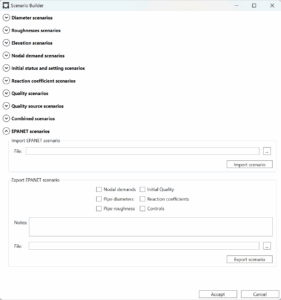
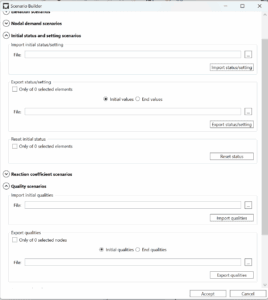
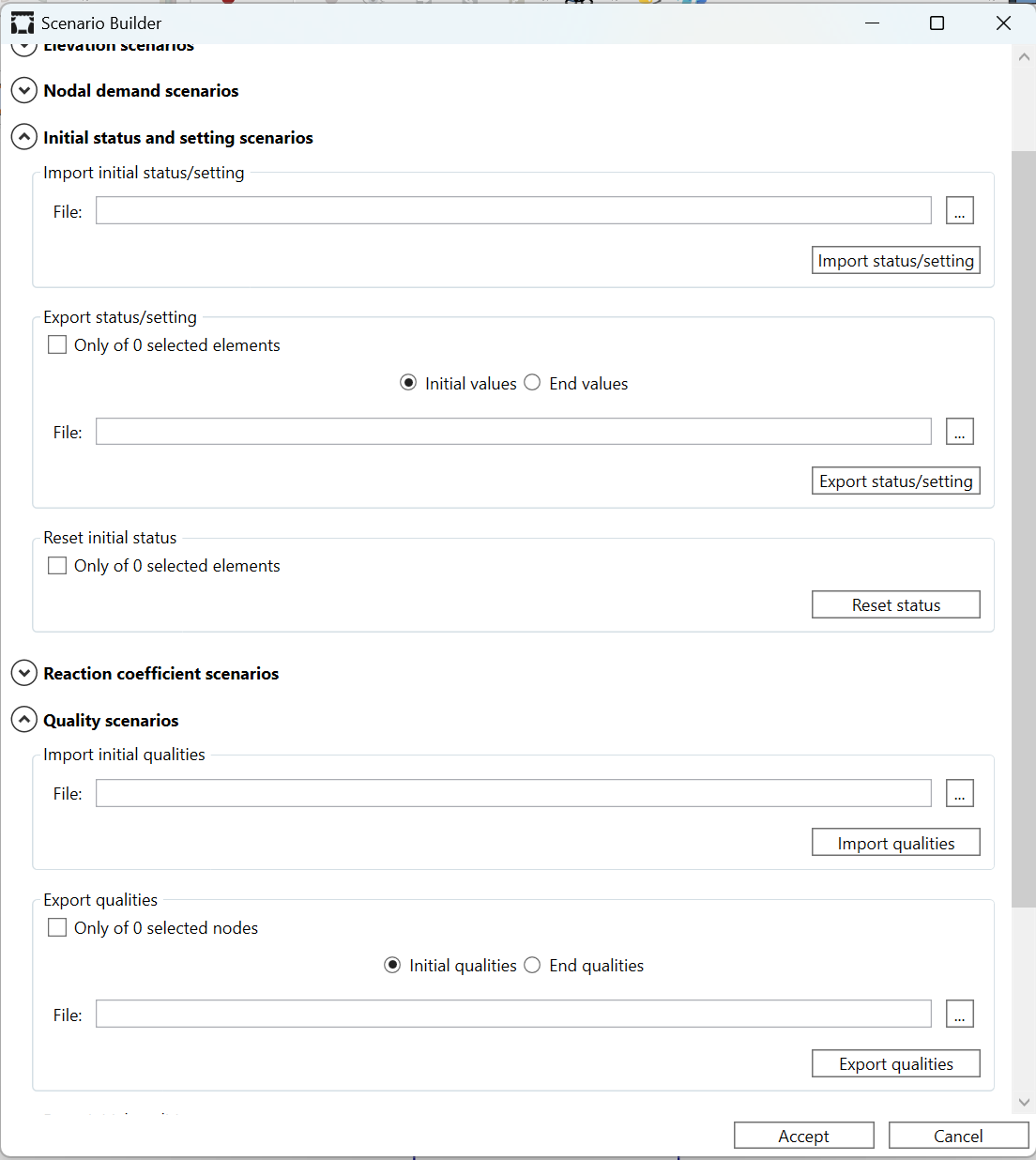
Version 0.17 of QGISRed now allows chaining simulations from the Scenario Manager by exporting the state and setpoints of regulation elements at the end of a simulation and reimporting them as the initial state for the next stage, taking the above considerations into account.
For water quality models, chaining simulations requires imposing the node qualities at the end of one simulation period as the initial qualities for the next period. This can also be done from the Scenario Manager in the new version of QGISRed.
A future tutorial will show in more detail how to easily chain simulations from QGISRed, opening the door to unlimited long‑term simulations, or alternatively splitting classic extended period simulations into chained independent simulations with short periods (1 hour or 15 minutes) for real‑time calculations.