
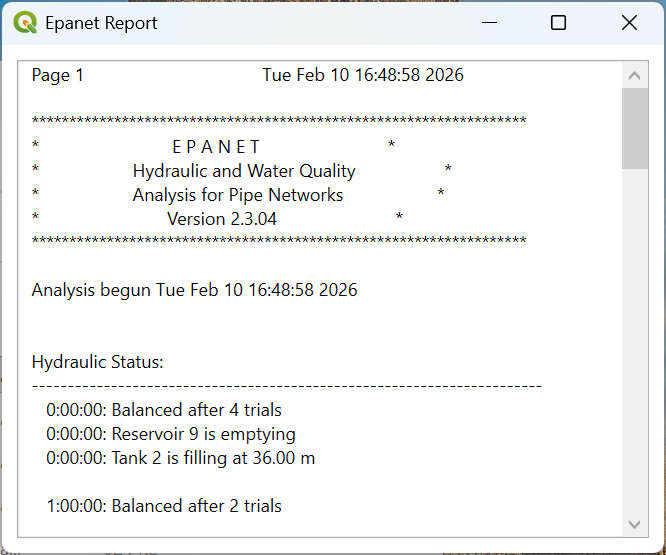
The EPANET Toolkit version 2.2 was released in 2019 and was incorporated into QGISRed in its early versions. Over the following five years, many improvements were made to the Toolkit, although its consolidation was slow. Finally, in July 2025, the new version 2.3 was released. It has subsequently been corrected four times, the most recent being version 2.3.4, released in February 2026.
Among the improvements introduced in the new version 2.3 of the Toolkit, the following are worth highlighting:
- Support for defining pipe leaks as a function of pressure and discharge area, the latter configured by a constant term and another term variable with pressure (modelo FAVAD).
- Introduction of a new valve type called Válvula de Control por Posición (PCV), whose head loss coefficient is related to the obturator position through the valve characteristic curve.
- Emitters can now behave as uni‑ or bidirectional elements.
- Pressures can now be expressed in up to four different units, independently of the flow units. In addition, flows can now also be expressed in m³/s.
- Outflows at nodes can now be broken down into: demanded, supplied, deficit, emitted, and leakage.
- Control rules can now be enabled or disabled.
- The Status Report now includes a flow and mass balance at the end.
- Various changes have also been introduced in the calculation algorithms to improve convergence conditions.
The new QGISRed v0.17 incorporates the most recent version 2.3.4 of the Toolkit, allowing users to benefit from all the improvements introduced in the calculation engine. However, improvements that affect data or results will be progressively incorporated in future versions of QGISRed. A tutorial will be published shortly to show in more detail the improvements offered by version 0.17 of QGISRed thanks to the integration of Toolkit 2.3.
One Response
Great work, really. If you’re planning improvements, it would be great to have a table in the isolated segments tool that lists valves with their IDs, and if you could quickly zoom in on them on the map or blink the object. Overall, it’s a very nice plugin. Congratulations again.